
January 22, 2026
By Tracie Troha
Graduate student Madison McKinnon is earning recognition for her research aimed at improving the precision and efficiency of brain cancer treatment.
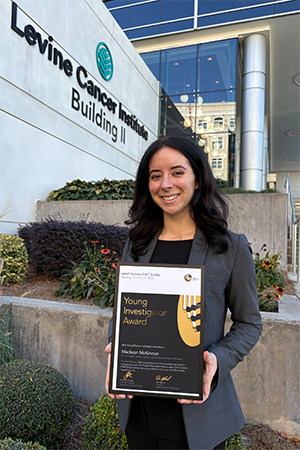
McKinnon, a second-year master’s student in the Nuclear and Radiological Engineering and Medical Physics program at the George W. Woodruff School of Mechanical Engineering, received the Young Physics Investigator Award from the Leksell Gamma Knife Society at their meeting in Stockholm, Sweden, in October.
At the meeting, McKinnon presented her research, Optimizing Gamma Knife Frameless Stereotactic Radiosurgery with the Printed Adjustable Radiosurgery Chin Support (PARCS) Device by Improving Treatment Accuracy and Decreasing Treatment Time. It was her third professional conference and her largest audience.
“I was nervous at first, but this project had been in the making for a year and a half,” McKinnon said. “I was excited and relieved to finally share it with an audience that was receptive to learning about it.”
The PARCS Device is a 3D-printed, adjustable chin support designed to prevent patient motion during frameless, mask-based Gamma Knife treatments. These treatments deliver highly focused radiation beams to brain lesions, requiring patients to remain extremely still. If patients move more than 1.5 millimeters, the machine will pause treatment, increasing the overall treatment time.
By attaching to the treatment headrest and supporting the patient’s chin, the PARCS Device helps stabilize patients during therapy. McKinnon’s study showed that the device reduced average patient motion by 0.26 millimeters, leading to a 7 percent decrease in treatment time.
“This is a device that I am very excited about. I really believe in its ability to make a difference in how we approach Gamma Knife radiosurgery and especially improving frameless, mask-based Gamma Knife treatments,” she said. “The recognition I've received for it is rewarding, both because of all the hours I've put into developing this device and because I hope it means that others see the impact the device could have as well.”
The device was developed in collaboration with David Piantino, chief Gamma Knife physicist at Atrium Health Levine Cancer Institute in Charlotte, North Carolina, where McKinnon works as a medical physics assistant. The project was completed at Atrium Health and funded by the health system. McKinnon attends Georgia Tech as a distance learning student. The PARCS device, named after Atrium Health’s Proton and Advanced Radiation Center (PARC), is patent-pending, with McKinnon and Piantino listed as inventors.
In addition to the Leksell Gamma Knife Society honor, McKinnon also received the George Sherouse Award for Trainee and Early Career Investigators from the Southeast Chapter of the American Association of Physicists in Medicine and presented her work at the group’s meeting in Knoxville, Tennessee.