January 29, 2026
By Tracie Troha
At first glance, mechanical engineering and honey may seem worlds apart. But for Georgia Tech alumnus Mike Everly, ME 1982, the analytical mindset he developed at the George W. Woodruff School of Mechanical Engineering laid the foundation for his unexpected and thriving international honey business.
Everly is the co‑founder of Bees & Trees Manuka Honey LLC, a U.S.-owned boutique brand producing premium Manuka honey in New Zealand’s Taranaki region. The company has built a loyal following among American consumers who are drawn to Manuka honey for its natural wellness properties. Its origin story, however, began with a leap of faith and a reinvention.
Engineering a Nontraditional Career Path
After earning his bachelor’s degree in mechanical engineering from Georgia Tech, Everly began his career as a field engineer in the oil industry before transitioning into management consulting with Ernst & Young. Along the way, he learned that a mechanical engineering education is less about a single career path and more about developing a disciplined approach to problem-solving.
“Mechanical engineering is such a good problem-solving general degree,” Everly said. “It trains you to think in a really disciplined manner. That directly applies to what I’m doing now.”
That foundation proved invaluable when a consulting project took Everly to New Zealand in the late 1990s. What began as a two‑week stint became a transformative three‑month stay for his family.
After returning home to Atlanta, Everly and his family spent years talking about going back. In 2009, they finally made the leap and relocated to New Zealand without a defined career plan.
“It was really just a leap of faith,” he said. “I’ll figure something out.”
What he figured out was Manuka honey.
Discovering Honey by Helicopter
While exploring a sustainable forestry investment in New Zealand’s North Island, Everly saw helicopters flying beehives into remote forested areas. That moment introduced him to the Manuka honey industry, a highly specialized and valuable product known for its antibacterial, antiviral, and anti-inflammatory properties.
Intrigued by both the business opportunity and the science behind the product, he began investing in beehives and soon found himself immersed in a complex agricultural operation that relies heavily on data, logistics, and precision.
Engineering Behind the Beekeeping
Producing high‑quality Manuka honey requires data‑driven precision. Each season, Everly’s team analyzes climate trends, soil temperatures, and weather patterns to predict the brief window when Manuka flowers bloom.
“You spend all year getting ready for this one crop, and you’ve got one shot at it,” he said. “If you have a good season, the flowering might last four or five weeks. But on a short season, you only have a three-week window to produce essentially your whole income for the year.”
To reach remote flowering regions, the team flies the hives in by helicopter and coordinates trucks, staging areas, and rapid extraction timelines. It’s an operation where, as Everly put it, “everything has to be executed really, really well.”
“If you get the hives in too early, the bees forage on other nectar, and it dilutes the content of the Manuka honey,” he said. “If you get them in too late, you can miss the season entirely.”
A Boutique Brand with Yellow Jacket Pride
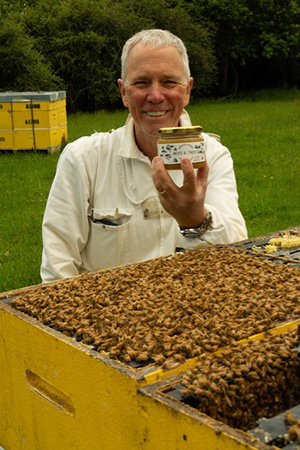
Today, Bees & Trees Manuka Honey sells 90% of its honey directly to U.S. consumers through its website and works with about 150 independent health food stores nationwide, including in Atlanta. The company remains intentionally small, focuses on quality control, and sources exclusively from the Taranaki microclimate, known for producing some of New Zealand’s best‑tasting Manuka honey.
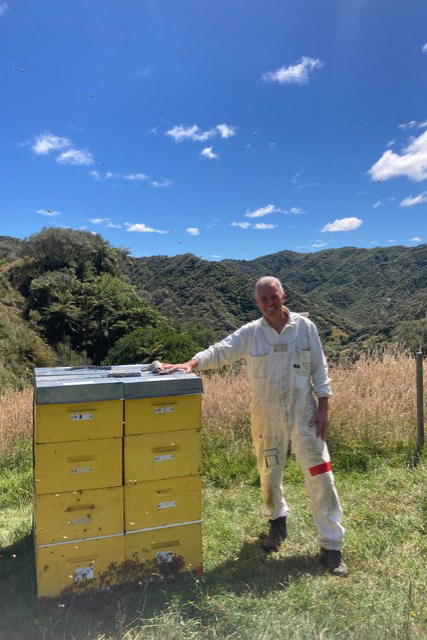
Even while building a business halfway around the world, Everly never lost his connection to Georgia Tech. A longtime Yellow Jacket supporter, he maintains strong ties to fellow alumni and his fraternity, Theta Chi. His company’s beehive boxes are painted Georgia Tech yellow, a nod to his alma mater that has become his signature in New Zealand’s close-knit beekeeping community.
“Only Georgia Tech people can really appreciate that,” Everly said, “But here in New Zealand, when people see the yellow boxes, they say, ‘That’s Mike Everly’s stuff.'”
Advice for Today’s Students
Reflecting on his winding career path, Everly’s advice to Georgia Tech students is to welcome unexpected opportunities.
“Stay open to all sorts of opportunities. You never know where things are going to take you,” he said. “And don't underestimate the benefits that can come from the interactions you'll have in a work environment, whether it's in an office, in a manufacturing facility, or wherever your job takes you.”
From oil rigs and consulting rooms to remote forests in New Zealand, Everly’s journey is a testament to the versatility of a mechanical engineering education and to the power of taking a leap when opportunity calls.