Woodruff School Team Ranks Among Top 10 of AI Drone Competition
September 10, 2026
By Tracie Troha
A team of Georgia Tech robotics and mechanical engineering graduate students and alumni ranked among the top 10 teams worldwide in the AI Grand Prix, an international autonomous drone racing competition.
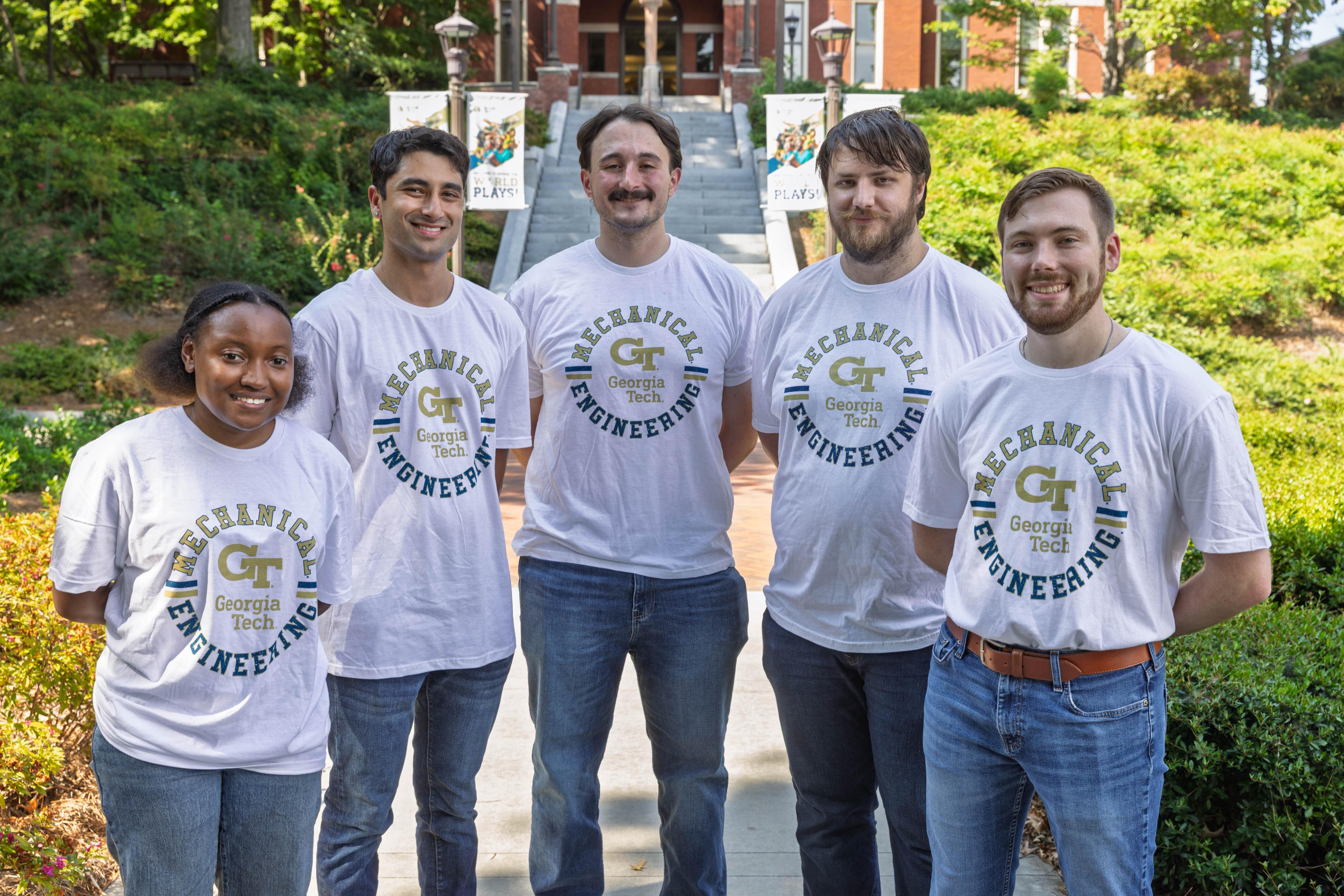
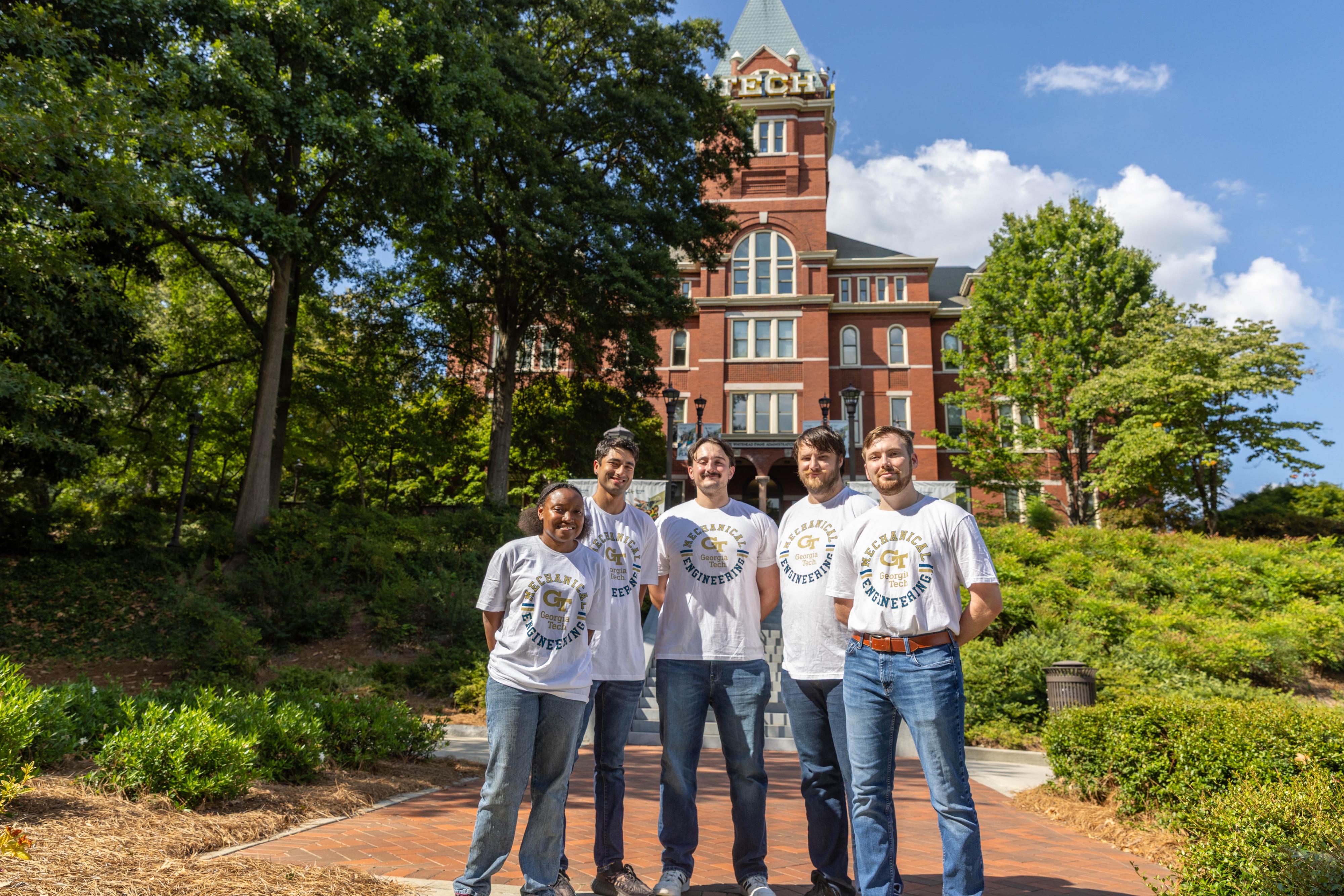
The team, called AI of Sauron, includes robotics Ph.D. students Johnathan Corbin, Alexander Gross, and Neel Shah; mechanical engineering Ph.D. student Brian Epstein; and alumna Sidney Wise, a Double Jacket who earned a bachelor’s degree in computer engineering in 2021 and a master’s degree in robotics in 2025. The team placed seventh out of approximately 3,000 teams worldwide during the virtual qualifying rounds of the competition, which was founded by defense technology company Anduril in partnership with the Drone Champions League and other organizations.
The team will travel to Costa Mesa, California, Sept. 15 – 22 for the competition’s next stage, where they will test their algorithms on physical drones for the first time.
The AI Grand Prix offers a $500,000 prize pool, and top competitors may receive a job opportunity with Anduril.
“I’m looking forward to seeing how the other teams compete,” said Gross. “Also, we’ll get an opportunity to network with people with international backgrounds and different perspectives.”
The Strategy Behind the Top-10 Finish
The AI Grand Prix challenges teams to develop software that can pilot high-speed racing drones autonomously through a professional-grade course. During the virtual qualifiers, competitors submitted their algorithms to a simulated racing environment and were ranked based on their fastest times.
AI of Sauron took a different approach from many competitors.
Rather than using reinforcement learning, a type of artificial intelligence that learns through repeated trial and error, the team relied on more traditional, model-based methods for perception, state estimation, and control.
“We didn't use reinforcement learning. We used more classical controls, which is what our labs do,” Corbin said.
That decision was intentional. The team knew that whatever worked in simulation would eventually have to perform on a physical drone, where small differences between virtual and real-world environments can create challenges.
“We went with an approach that we thought would be a lot safer and also a lot more suitable, specifically thinking about the hardware world first,” Epstein said.
Gross said the team drew from existing research and approaches used in previous drone competitions, combining those ideas with its own implementation.
The result was a flight stack that produced a lap time of approximately 17 seconds in the second virtual qualifier, earning the team a spot in the next stage of the competition.
From Simulation to Reality
The team now faces the challenge of making its virtual system work on actual drones.
During the third qualifying round in California, competition organizers will provide each team with four identical 8-inch quadrotor drones. The teams will have to transfer their algorithms to the hardware and navigate a physical course modeled after professional drone racing.
The drones will fly through a series of racing gates inside a warehouse, completing two laps of the course as quickly as possible. The gates are 1.5 meters by 1.5 meters.
The physical drones will have limited information available to them. Their primary visual input will come from a single forward-facing camera, supplemented by information such as acceleration and rotation.
“We can only measure from a camera,” Epstein said. “We get a picture from a camera on the front, and then we get how fast the drone is spinning, and which way is down.”
The team will not know its exact position on the course. Instead, its system will have to use the available sensor information and visual data to determine where the gates are and how to navigate toward them.
For Epstein, that transition from simulation to hardware is one of the most exciting parts of the competition.
“I’m excited to just see if our team’s approach works,” he said. “It’s like, OK, we did this thing in simulation, but simulation only goes so far.”
From a Weekend Side Project to the World Stage
The team formed in June and initially approached the competition as a side project.
Most of the members already knew one another through the robotics program. With their combined experience in aerospace, robotics, controls, and drone hardware, they decided to see how competitive they could be.
They didn't have months of dedicated preparation. Instead, they worked on the project around classes, research, and other commitments.
“We just kind of did it on the weekends,” Shah said. “We put in a few hours here and there. When they published the first leaderboard, and we saw we were in the top 10, that’s when we went gung-ho with it.”
After finishing seventh in the virtual qualifiers, the team is now preparing to compete against groups representing universities, companies, research organizations, and individual competitors from around the world.
During the California qualifier, the first few days will be focused on prepping the drones, with the races scheduled for Sept. 20 – 21.
“We'll be working from 7 a.m. to 10 p.m. testing algorithms and doing test flights,” he said.
One Step Closer to the Finals
For Gross, the trip will be supported in part by the Woodruff School. He received Woodruff Fellow funds from Anirban Mazumdar, associate professor and Woodruff Faculty Fellow, to help cover travel expenses. Gross said Mazumdar viewed the competition as a valuable career development opportunity and offered to help support his participation.
The Woodruff School team is not the only Georgia Tech team competing in the AI Grand Prix. The Daedalos Team, supported by the Autonomous Control and Decision Systems Laboratory in the Daniel Guggenheim School of Aerospace Engineering, is among the top three teams from the qualifying rounds. The multidisciplinary team includes aerospace engineering graduate and undergraduate students Jai Doshi, Maaz Dossa, Aanchal Save, Akash Ratheesh, and Zhiyuan Zhang; computer science master’s student Robert Azarcon; electrical engineering undergraduate Aaditya Dhar; and robotics Ph.D. student Darren Lie.
The teams' goals in California are straightforward: get their algorithms working reliably on the physical drones and see how they perform against the other finalists.
But for the members of AI of Sauron, the competition is also about seeing whether an idea that worked in a simulator can perform in the real world.
“We’re just doing it for fun,” Gross said.