
June 16, 2026
By Tracie Troha
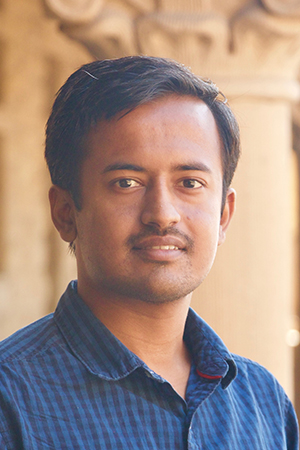
Suhas Jain, assistant professor in the George W. Woodruff School of Mechanical Engineering with a courtesy appointment in the Daniel Guggenheim School of Aerospace Engineering, has received a Faculty Early Career Development (CAREER) Award from the National Science Foundation's Division of Chemical, Bioengineering, Environmental, and Transport Systems.
The NSF CAREER Award, one of the foundation's most prestigious honors for early-career faculty, provides $548,708 over five years to support Jain's project to advance the understanding and prediction of gas-liquid flows, the complex interactions between liquids and gases that influence natural phenomena and critical engineering systems.
“The NSF CAREER Award is especially meaningful to me because it provides an opportunity to pursue a long-term research vision aimed at fundamentally advancing our understanding of complex multiphase flows,” Jain said. “Getting the award in my first attempt is a validation of the importance of the scientific questions we are pursuing and the potential impact of the work. It also reflects the support of my students, collaborators, mentors, and colleagues at Georgia Tech, who helped create an environment where interdisciplinary ideas can thrive.”
Gas-liquid flows are found everywhere, from ocean waves, clouds, and rainfall to the exchange of gases in human lungs. They are equally important in engineering systems, such as chemical reactors, pipelines, energy systems, combustion devices, and aerospace applications. Despite their prevalence, these flows remain notoriously difficult to predict.
"Small errors in modeling bubbles or droplets can significantly affect predictions of mixing, heat transfer, chemical reactions, and overall system performance," Jain said.
Through the project, Jain and his team at the Center for Multiphase flow Research and the Flow Physics and Computational Science Lab will investigate how the interfaces separating liquids and gases stretch, wrinkle, break apart, and reconnect. The research combines advanced computational modeling, high-fidelity simulations, and theoretical analysis to improve scientists' ability to predict these complex processes. The team will leverage Frontier and Aurora, two of the world's most powerful supercomputers at the Department of Energy's Oak Ridge and Argonne Leadership Computing Facilities, and ExaFlow, a GPU-accelerated exascale simulation framework developed by Jain's group at Georgia Tech, to generate unprecedented simulation datasets and develop next-generation predictive models for complex multiphase flows.
"Ultimately, better models enable better engineering decisions while reducing the need for costly trial-and-error experimentation," he said. “The ability to accurately predict multiphase flows remains one of the grand challenges in fluid mechanics, and addressing that challenge has the potential to impact many sectors of society.”
The award also supports summer research experiences for high school students, interdisciplinary research opportunities for undergraduates through Georgia Tech's Vertically Integrated Projects program, and advanced training for graduate students and postdoctoral researchers.
“Students will contribute to cutting-edge research in computational fluid dynamics, high-performance computing, machine learning, and multiphase-flow modeling while developing skills in leadership, communication, teamwork, and scientific problem solving,” Jain said.
Jain views mentorship as an essential part of the project's long-term impact.
"The most lasting impact of scientific work comes not only from the discoveries we make, but also from the people we help train along the way," he said.
Receiving the CAREER Award represents an important milestone in Jain's career and an opportunity to pursue a long-term research vision.
"The award provides an opportunity to build a lasting research and educational program whose impact extends well beyond the five-year duration of the project,” he said.