
October 30, 2026
By Tracie Troha
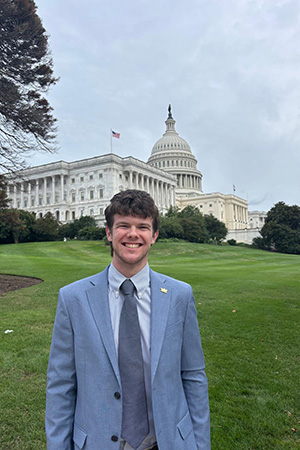
Sam Woolsey, a fourth-year mechanical engineering major in the George W. Woodruff School of Mechanical Engineering, had the opportunity to meet with members of Congress and other policymakers in Washington, D.C., as part of the Nuclear Engineering Student Delegation (NESD).
The NESD is an independently organized, student-run program that gives students interested in nuclear science and engineering hands-on experience with the political process and opportunities to learn how they can positively influence the future of nuclear energy, policy, education, and research.
As part of the NESD, Woolsey and other members of the 2026 delegation traveled to Washington, D.C., Sept. 20–25 to discuss current nuclear legislation with policymakers, members of Congress, and representatives from the Nuclear Energy Institute, Nuclear Regulatory Commission, Breakthrough Institute, Department of Energy, and White House Office of Science and Technology Policy.
Woolsey and his fellow delegates spent the first day developing a policy statement, then devoted the rest of the week to meeting with stakeholders and presenting the statement to congressional offices.
“It was an eye-opening experience to meet with industry groups, NGOs, and government agencies, learning the intricacies of the policymaking process,” he said. “I was especially inspired to see the bipartisan support that nuclear has as we look for energy that is safe, reliable, low-carbon, and provides energy security.”
Woolsey learned about the NESD from former delegate and Woodruff School alumna Anna Schafer, NRE 2025. The two worked together to plan multiple panels about nuclear energy as part of Georgia Tech’s Energy Club and American Nuclear Society student chapter.
“Since coming to Tech, I've been interested in the role public policy can play in a clean energy transition,” Woolsey said. “NESD appealed to me because it approached policy from an engineering student perspective, with students leading other students to advocate for what we believe in. I was honored to be selected, especially because while I come from a renewable energy background, I was able to apply that perspective to support nuclear policy.”
Woolsey said his experience with the 2026 NESD gave him motivation and perspective as he continues his research career.
“As I pursue graduate studies, I will remember these lessons on how industry and government help technology go from concept to reality,” he said. “I am incredibly grateful to the NESD organizers for this opportunity to apply my engineering education in a completely new context.”
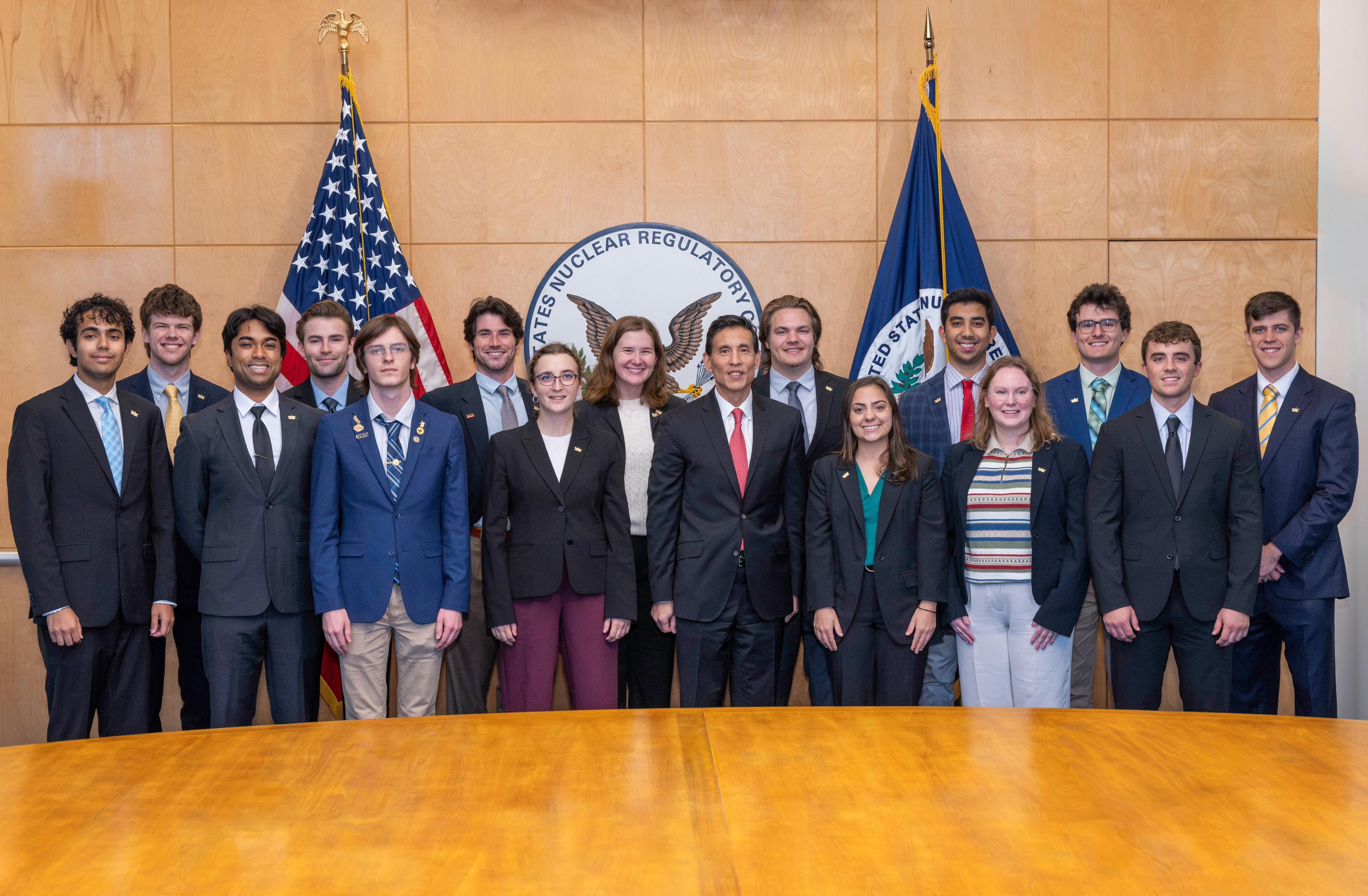
The NESD at the Nuclear Regulatory Commission (NRC), with NRC Chairman Ho Nieh.