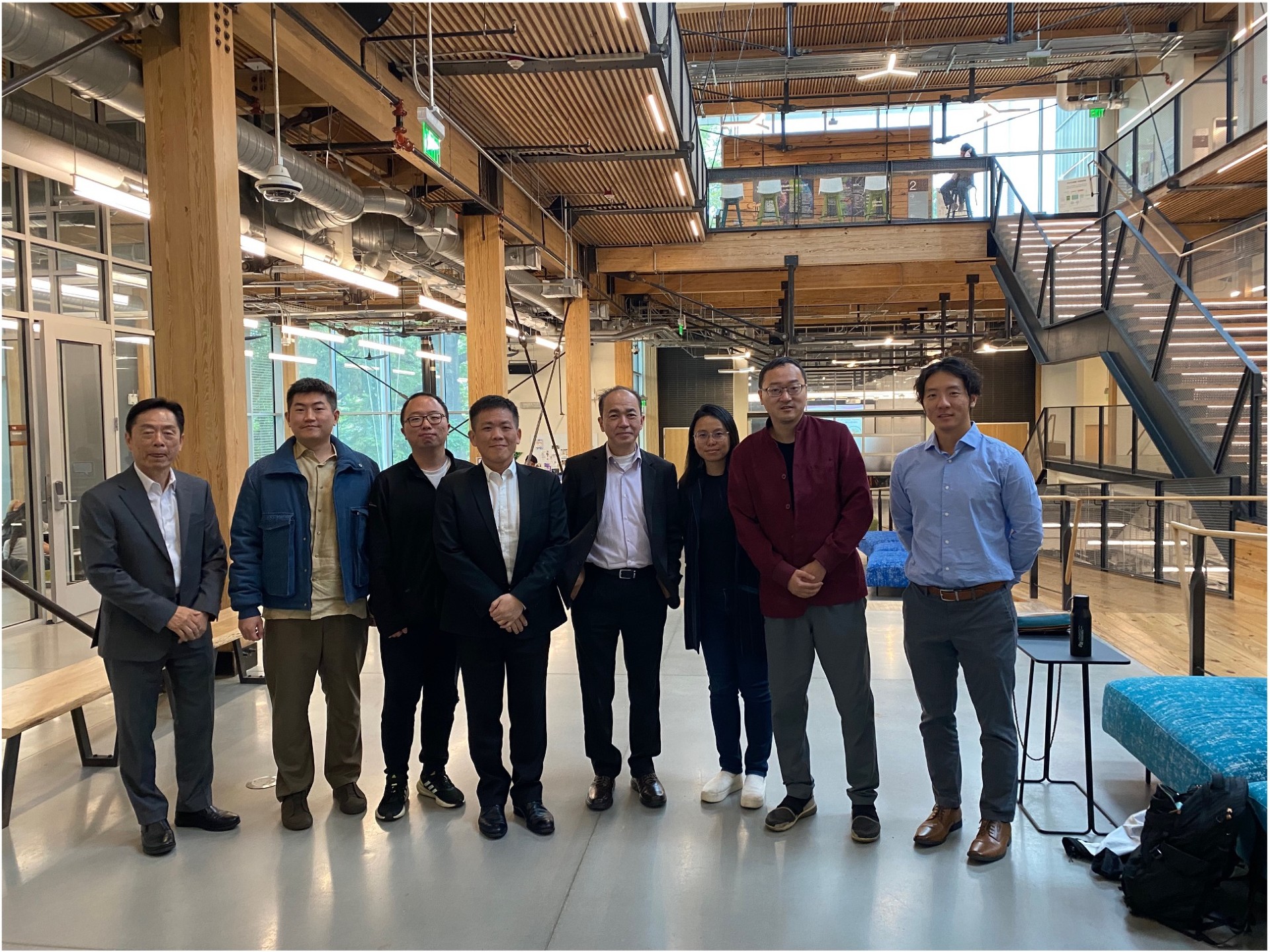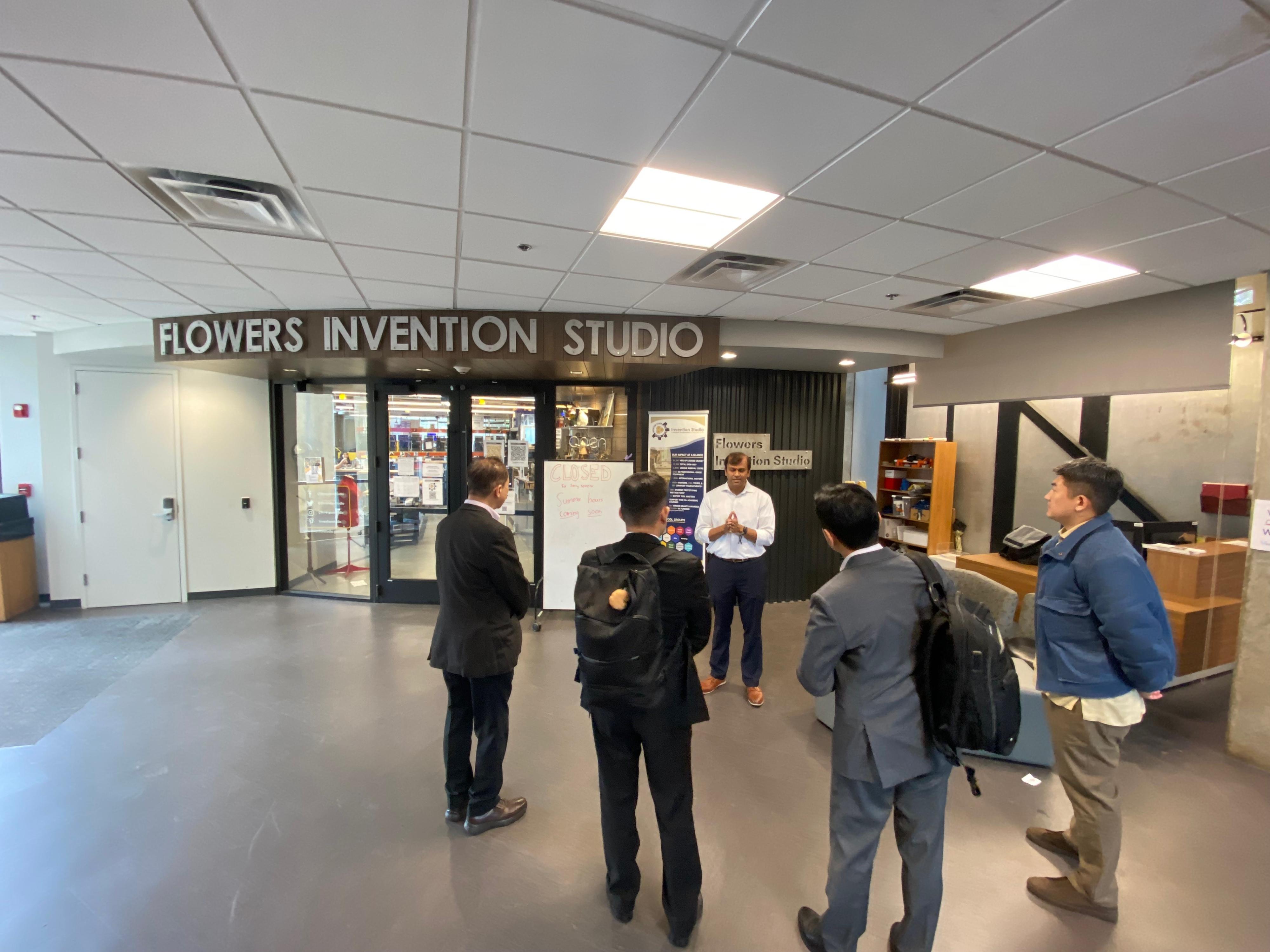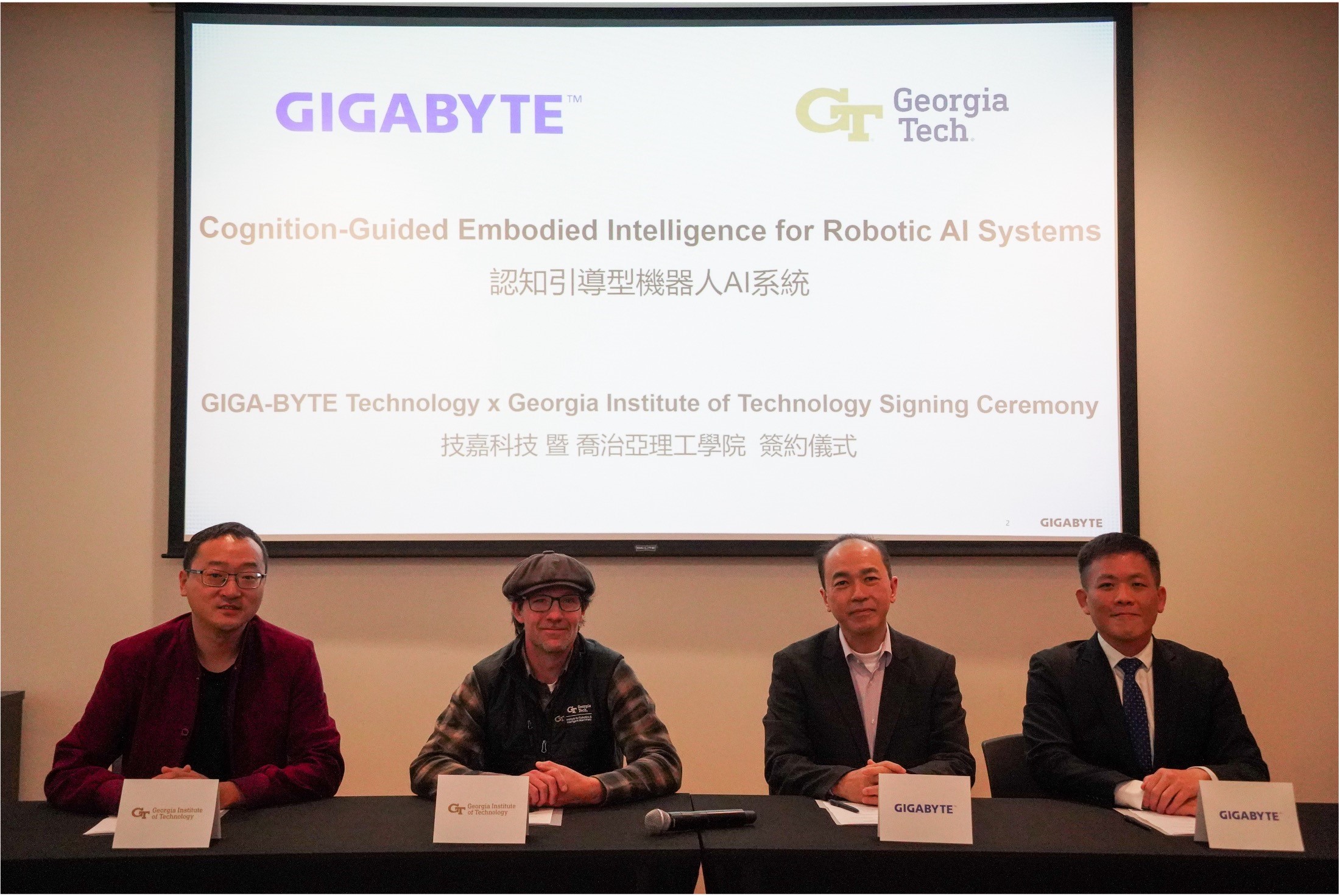
Pictured: Associate Professor Ye Zhao and IRIM Interim Executive Director, Joseph Anderer Faculty Fellow, and Woodruff Professor Gregory Sawicki with GIGABYTE executives who visited Georgia Tech in April for a signing ceremony launching the partnership.
GIGABYTE Grant Supports Robotics and AI Ecosystem at Tech
June 12, 2026
By Tracie Troha
Georgia Tech’s Laboratory for Intelligent Decision and Autonomous Robots (LIDAR) was awarded a $1 million, three-year industrial grant from GIGABYTE to advance robotics and artificial intelligence (AI) research, with a focus on helping robots better interact with the real world.
The grant will support building a robotics and AI ecosystem for dexterous and mobile manipulation, enabling robots to move through environments, interact with objects, and adapt to changing conditions.
Ye Zhao, LIDAR director and associate professor in the George W. Woodruff School of Mechanical Engineering, leads the project, with Anqi Wu, assistant professor in the School of Computational Science and Engineering, serving as co-principal investigator.
Taiwan-based GIGABYTE is a computing hardware and infrastructure company specializing in AI servers, edge computing, and high-performance computing systems. Through the collaboration, researchers will develop the GIGABYTE Robot AI Platform, which Zhao described as a foundation for robot learning, deployment, and integration across different robotic systems and applications.
“A major research direction is to advance robot foundation models that can help robots reason about objects, actions, environments, and task outcomes,” Zhao said. “The project will connect Georgia Tech's strengths in robotics, AI, edge computing, and human-centered technology with GIGABYTE's expertise in computing hardware and systems.”
A central research focus is improving robots’ ability to perform complex tasks, particularly those that require fine motor skills and mobility. Researchers aim to improve robot perception, navigation, planning, manipulation, and decision-making.
“A concrete example is self-service coffee making, where a robot needs to recognize cups and tools, operate a machine, handle objects safely, and sequence several actions together,” Zhao said. “Robot foundation models and world models will be important for this direction because they can help robots generalize across tasks, anticipate the effects of their actions, and adapt when conditions change.”
The project also emphasizes integrating mobility and manipulation, allowing robots to move through confined spaces, approach tasks, and carry out coordinated actions. Researchers will explore AI models, simulation tools, and parallel computing that make these capabilities easier to develop and deploy.
The grant also creates opportunities for students and researchers to work on projects that connect fundamental robotics research with industry needs. Students will gain experience in areas including robot foundation models, simulation-to-real-world training, edge AI deployment, and multi-robot systems.
“The project also creates a platform for collaboration across disciplines, including mechanical engineering, computer science, robotics, AI, and interactive computing,” Zhao said. “For researchers, the grant provides resources and an industry partnership that can help translate new methods into deployable systems and open up additional research directions.”
Two interdisciplinary research institutes, the Institute for Robotics and Intelligent Machines (IRIM) and the Institute for People and Technology (IPaT), are participating in the project. IRIM Interim Executive Director Gregory Sawicki, IPaT Executive Director Michael Best, and Shelton Chan, managing director for international development, will help connect the project with Georgia Tech's broader robotics, AI, and human-centered technology communities.
Zhao said the partnership with GIGABYTE could help make advanced robotics more accessible for students, researchers, and makerspaces while creating new opportunities for industry-sponsored research and collaboration.
“In the long term, this work could help move robotics from specialized demonstrations toward more useful everyday tools that support people in workplaces, public spaces, and homes,” Zhao said.
GIGABYTE executives visited Georgia Tech in April for a signing ceremony launching the partnership.