Georgia Tech-led Research Team to Develop SHIELD Against Deadly Biological Threats
April 1, 2026
By Tracie Troha
The United States continues to face deadly infectious disease outbreaks, from emerging viruses to antibiotic-resistant bacteria, underscoring the nation’s need for rapid, effective response systems. These threats extend beyond public health, disrupting daily life, straining health care systems, and impacting military readiness.
A team of researchers led by Ankur Singh, the Carl Ring Family Professor in the George W. Woodruff School of Mechanical Engineering and professor in the Wallace H. Coulter Department of Biomedical Engineering at Georgia Tech and Emory University, has been awarded up to $6 million from the Defense Threat Reduction Agency (DTRA) of the U.S. Department of Defense to accelerate the development of medical countermeasures (MCMs) against deadly biological threats that endanger public health, national security, and warfighters.
DTRA’s mission is to provide solutions that enable the Department of Defense, the U.S. government, and international partners to deter strategic threats. A key priority is advancing new or improved MCMs that can be deployed before or after exposure to biological or chemical agents.
Singh’s multi-year project, Systematic Human Immune Engineering for Lethal Disease (SHIELD) Countermeasures, aims to create a threat-agnostic platform that transforms how respiratory pathogens and toxins are studied. The platform is designed to speed up the discovery, development, and production of immune-based countermeasures.
Singh leads a collaborative team that includes Cornell University’s Matthew DeLisa and Stanford University’s Michael Jewett. Together, they will integrate immune-engineering technologies with advanced cell-free protein synthesis platforms to discover and manufacture protein-based MCMs. Cell-free protein synthesis is a laboratory technique that efficiently produces proteins without relying on living cells, which can be unpredictable and technically demanding when it comes to expressing complex or toxic proteins and scaling production quickly. The team expects the SHIELD Countermeasures platform to reduce the time and cost of MCM development by more than tenfold.
“The foundational science and cutting-edge tools we develop will ignite future discoveries, ensuring a robust pipeline of advanced protein-based MCMs for chemical and biological defense,” said Singh, who also directs the Center for Immunoengineering at Georgia Tech. “This will significantly enhance national security and equip our warfighters with next-generation biodefense capabilities."
Traditional animal models often fail to accurately replicate human immune responses, and standard tissue cultures lack the complexity required to study how immune cells interact with pathogens. In contrast, human immune organoids and immune-competent devices — built from human cells — are emerging as groundbreaking research tools. These systems recreate key immune features, such as lymph nodes and mucosal environments, within three-dimensional or microengineered platforms.
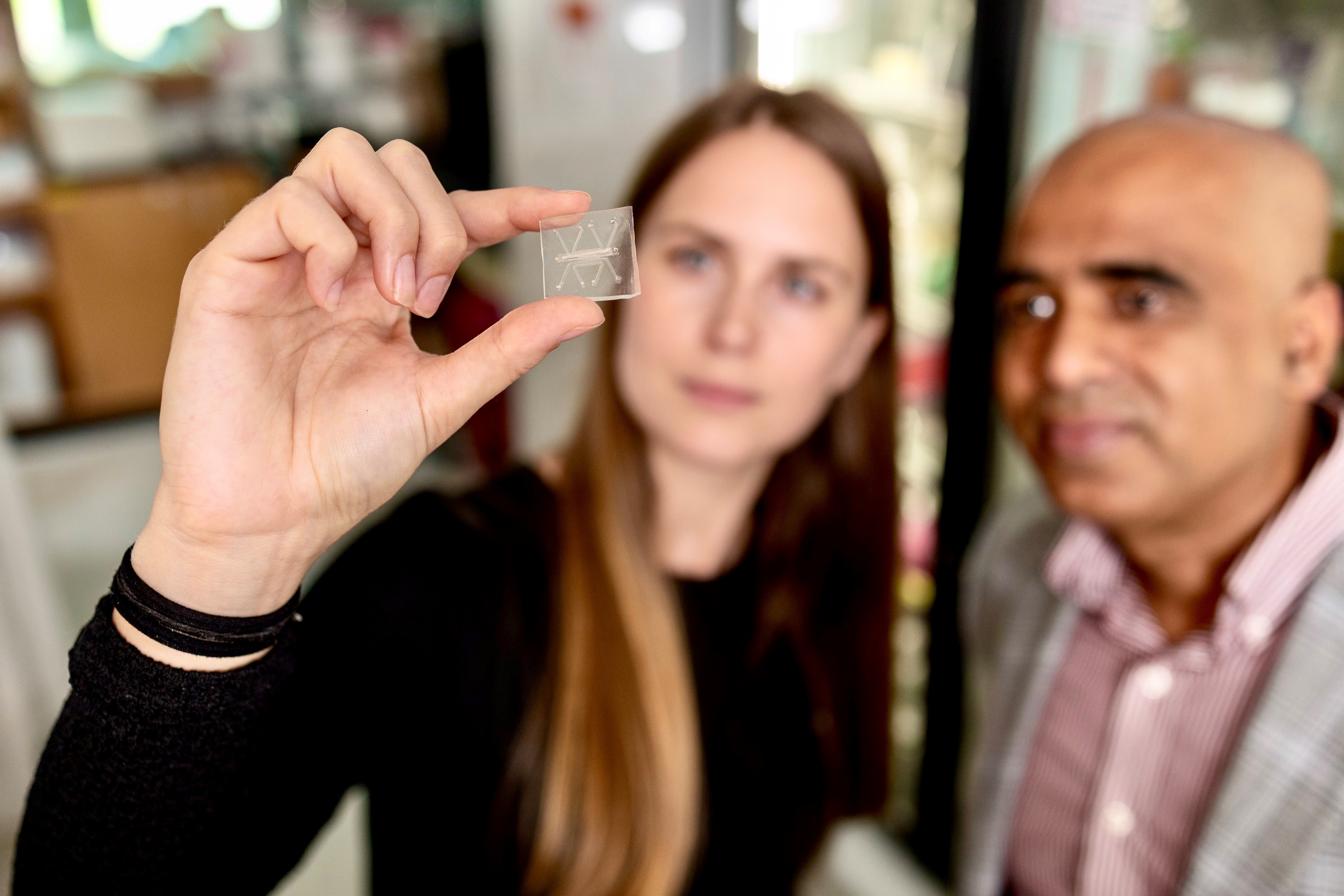
“Many organoid and engineering devices, often called organ-on-chip platforms, lack immune integration,” Singh said. “Because immunity sits at the center of human health, these limitations have broad consequences. Immune-competent organ-on-chip platforms extend this concept by combining human cells with microfluidic engineering that simulates blood flow, tissue barriers, and chemical gradients.”
Singh has previously published studies on a synthetic human immune chip and an immunocompetent lung on a chip, and has also teamed up with DeLisa previously to use synthetic immune organoids for immuno-profiling antibacterial MCMs.
“It’s about being able to test far larger numbers of candidate protein-based MCMs in a single experiment—and to do it much faster,” DeLisa said. “Cell-free systems allow us to produce MCMs at unprecedented speed and scale, but traditional evaluation methods can’t keep up with those numbers. By combining cell-free MCM production with immune organoid technology, we can assess the potency of dozens or even hundreds of candidates at a time and characterize the resulting immune responses within just a few days.”
By integrating immune cells with tissues such as lung, gut, skin, or vascular systems, these devices allow scientists to observe immune responses in real time, including cell migration, inflammation, and interactions with pathogens or therapeutics. As biological threats evolve, the development and deployment of immune-competent platforms will be critical for rapid, effective countermeasures.
DTRA’s investment in Singh’s work highlights the urgent national priority of strengthening U.S. biodefense capabilities. The SHIELD Countermeasures platform and its cutting-edge technologies promise to transform the nation’s response to biological threats and help safeguard communities from biological and chemical attacks.